Lately, I have been taking a stroll down memory lane. It started as a personal refutation of something someone recently claimed about me and collapsed into a rabbit hole deeper than Alice’s. After a few days of eating the cake and drinking from the vial, I have come to realize a few things about a lived life.
The first is obvious: Resumes compress us until most of the meaningful parts disappear. For years, we have been told to keep them brief (preferably no more than two pages) and customize them for every position. LinkedIn was supposed to restore some of the detail that gets lost. Instead, we compress that too. We rewrite. We optimize. We abstract. Eventually, the professional version of ourselves becomes so polished that we are no longer quite sure which person is supposed to show up for the interview.
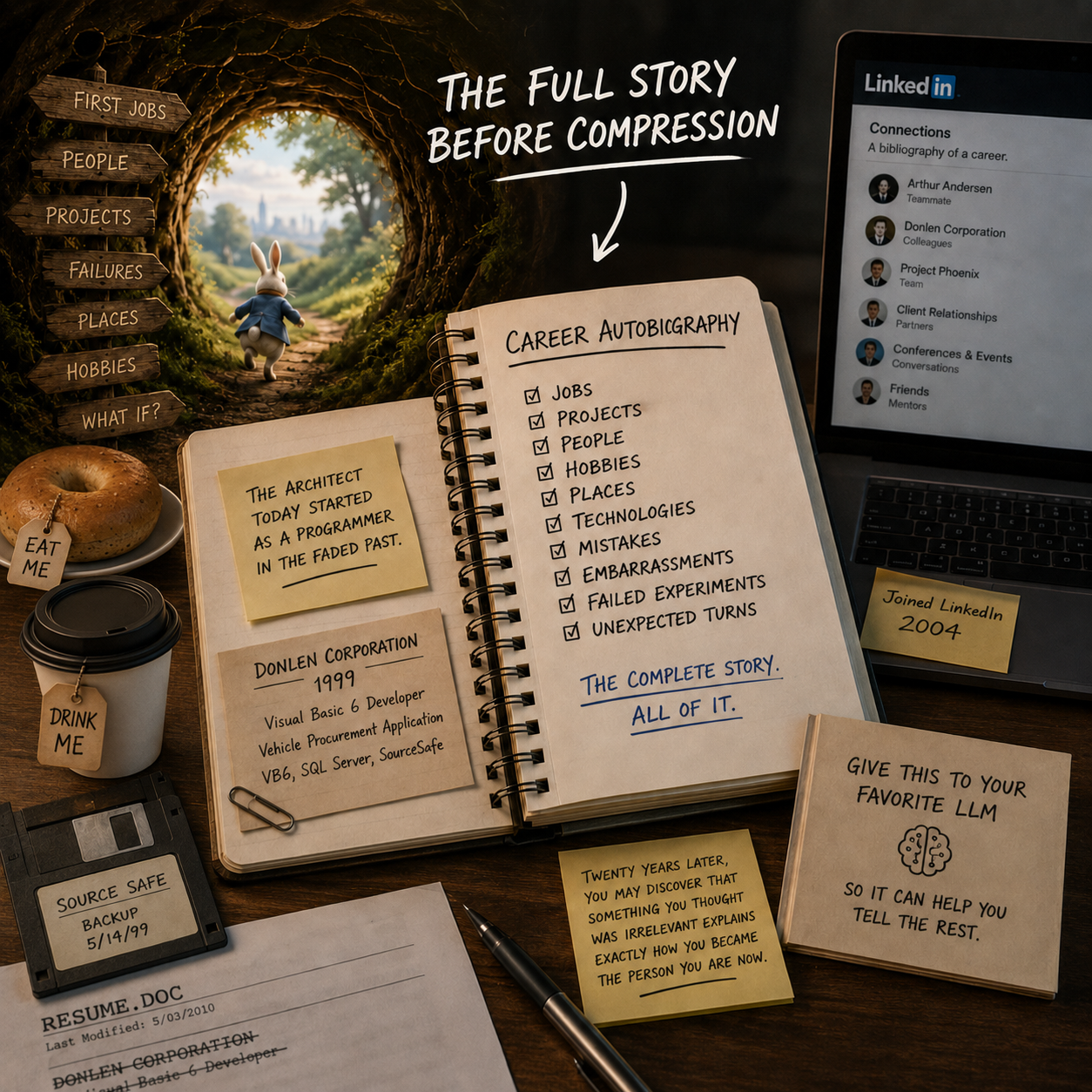
And some things simply disappear. For me, it was Donlen Corporation. Early in my career, I worked there as a Visual Basic 6 programmer. Over time, that job slowly fell off the bottom of my resume in the pursuit of brevity. Then, apparently, it fell out of my memory. I rediscovered it on a 15-year-old resume sitting on an old hard drive. There it was: evidence that in 1999 I had a job building a vehicle procurement application with Visual Basic 6, SQL Server, and SourceSafe.
The architect today started as a programmer in the faded past.
I joined LinkedIn in 2004, a year before Steve Jobs gave his famous Stanford commencement speech about connecting the dots. My first LinkedIn connection was a teammate from my Arthur Andersen days: two years after Andersen had collapsed. Scrolling through my connections now, I see people from projects, employers, clients, conferences, successes, disasters, and strange little side roads that once seemed unimportant. LinkedIn, at its best, is not really a resume. It is the bibliography of a career.
And that gets at the lesson I have taken from this exercise: You need a career autobiography.
Not a resume. A document containing the jobs, projects, people, hobbies, abandoned ideas, failed experiments, places, technologies, mistakes, embarrassments, and unexpected turns that make up the unstated life you actually lived. Include the failures. Include the contradictions. Include the things you would never put on a resume. Include the personal circumstances that shaped your decisions, your shortcomings, and occasionally your dismissals.
Write down the complete story before compression convinces you that parts of it never happened.
Because twenty years later, you may discover that something you thought was irrelevant explains exactly how you became the person you are now. And that is what you give your favorite LLM when you ask it to write yet another two-page resume.
Not because the machine knows who you are.
Because you finally gave it something better than a compressed version of yourself to work from.
Also published on LinkedIn.