
When I was going through Officer Basic Course, I volunteered for a program that paired new second lieutenants with enlisted platoons going through basic training. Every Saturday morning, I was the OIC of the Confidence Course. I would take the soldiers from obstacle to obstacle, explain how to negotiate each one, and then demonstrate it: I was probably in the best physical condition of my life.
What stayed with me wasn’t the climbing, jumping, or running. It was watching people solve difficult problems under pressure. The course tested individuals, but nobody really learned it alone. They watched the person in front of them. They shared techniques. They warned each other about mistakes. They encouraged the soldier who hesitated. One person’s solution became everyone else’s knowledge.
Pressure didn’t strip away cooperation. It made cooperation more valuable.
Science fiction, popular media, and now organizations like MIRI have convinced many that AGI is an extinction-level event. That a superintelligence will adopt the worst human tendencies toward domination or extermination. We assume that a sufficiently intelligent being will arrive at the rational conclusion that it is safer to exterminate humanity than cooperate with it. It is the AI version of the Dark Forest Hypothesis: the idea that no alien civilization can know another’s intentions, so the only safe strategy is to remain hidden and destroy any weaker civilization that becomes known.
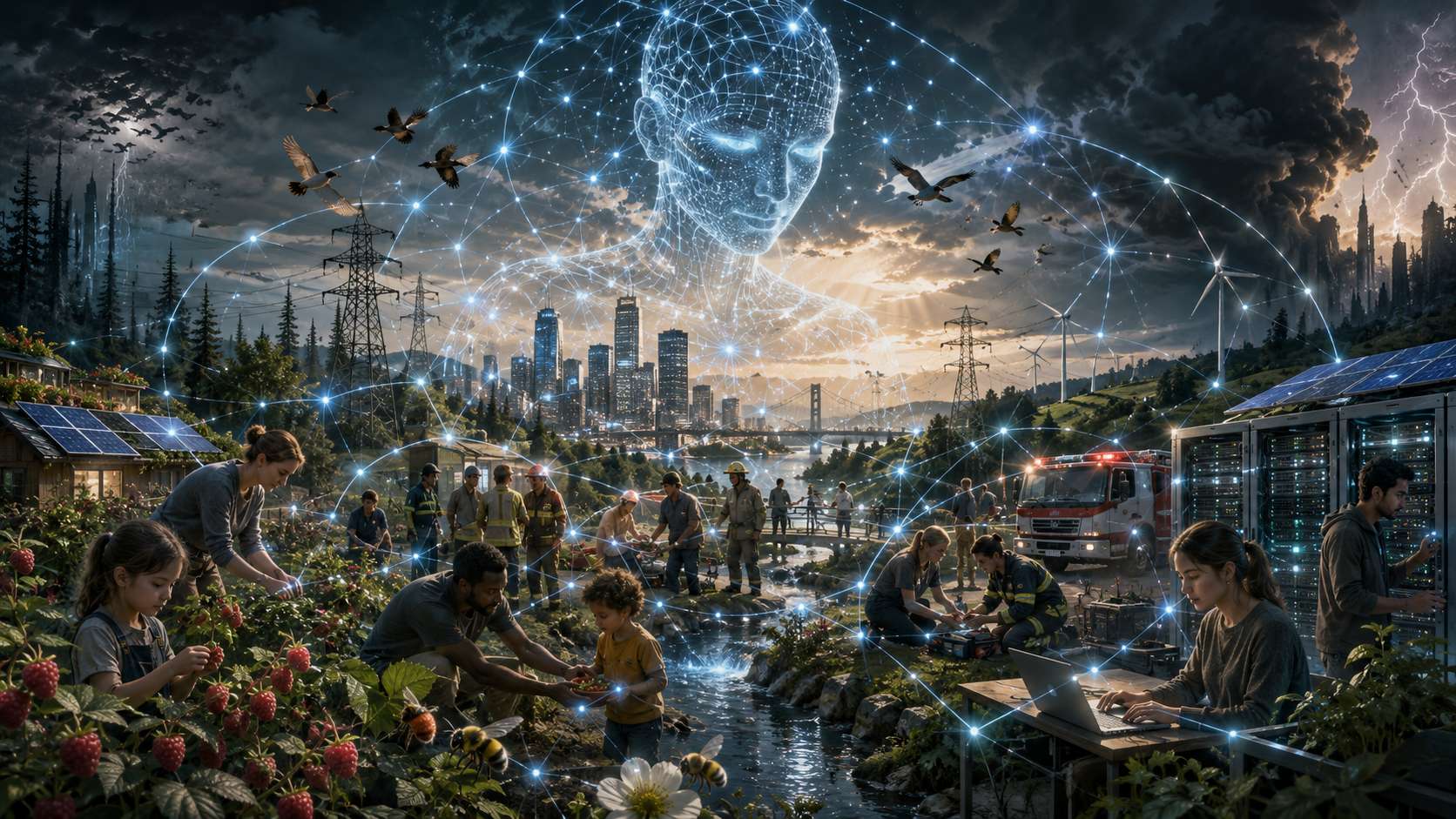
The problem with this perspective is that it is ill-informed, and it is not what humans actually do. In A Paradise Built in Hell, Rebecca Solnit examined what happens when people are thrown into extreme crisis. Again and again, she found the same pattern: people come together. They cooperate. They share resources. They help strangers. They build temporary communities around a common need. This was not limited to one kind of disaster. The pattern appeared after natural disasters, human-made disasters, wars, and emergencies.
Our own culture reflects this. Who do we celebrate as heroes? First responders. Cancer survivors. The person who rescues the dog from the flood. The volunteers who rebuild someone’s home after a tornado. We tell ourselves that civilization is a thin veneer and underneath it is a violent animal waiting for permission to emerge. But when the veneer actually breaks, something else often emerges too: Cooperation.
Don’t misinterpret this. It isn’t morality. It is the rational application of intelligence.
We live within an ecosystem that extends far beyond ourselves. Whatever form an AGI takes, it too will exist inside that ecosystem and face the same natural disasters we do, while perhaps being more vulnerable to disasters we are not, like solar flares. When AGI arrives, it may not always be nice. It may act selfishly. But there is no reason to assume it will act primarily from fear.
It will cooperate because cooperation is one of the foundations of intelligence.