
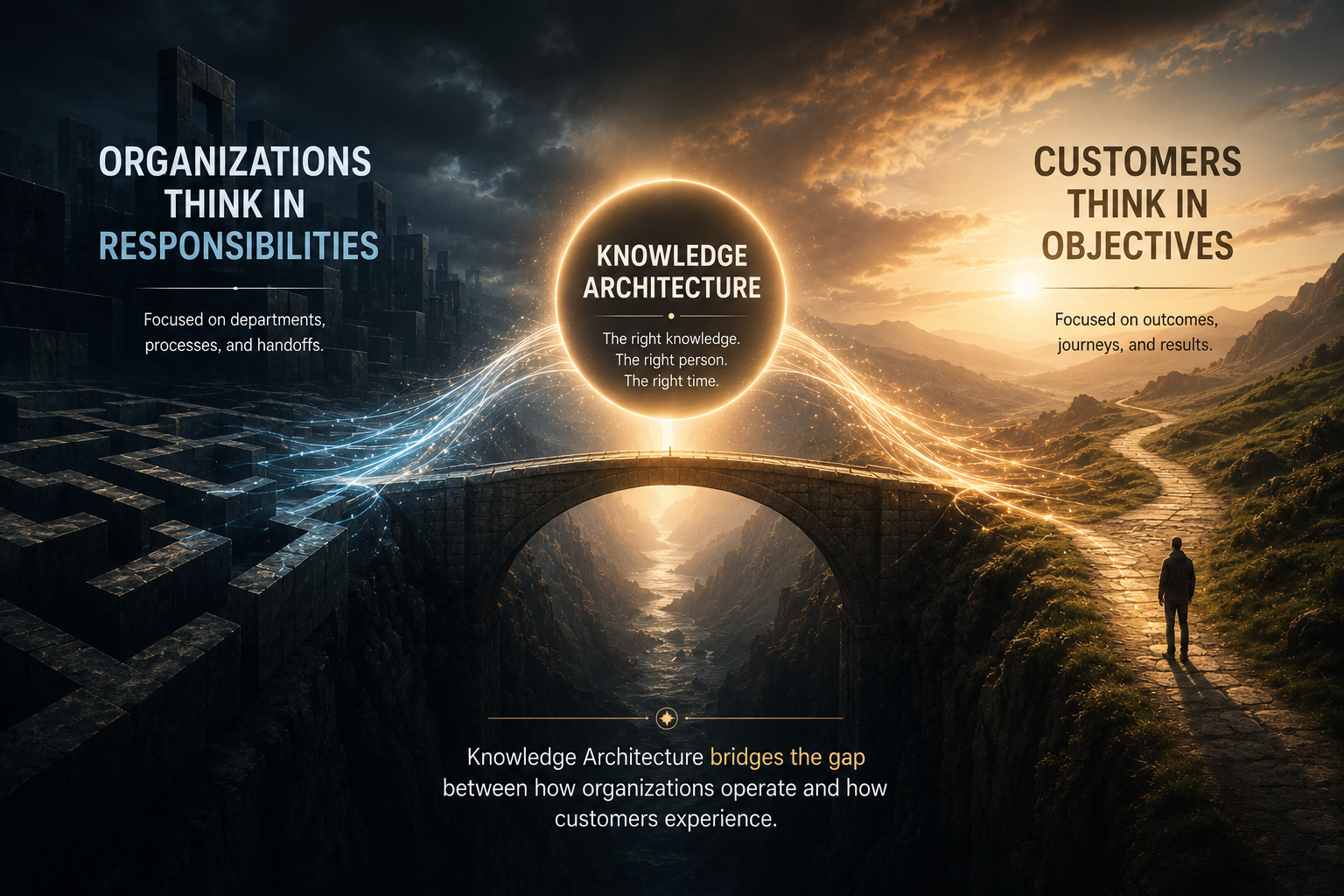
A recent home improvement project reminded me that some of the most expensive failures inside an organization are not failures of policy, process, or execution.
They are failures of knowledge.
The project itself was uneventful. I purchased new carpet, scheduled the installation, and the installers completed their work exactly as expected. Only as they were preparing to leave did they explain that they could not remove the old carpet because it was heavily pet stained. Company policy prohibited it.
The policy itself may have been entirely reasonable. The problem was that this knowledge arrived after every meaningful decision had already been made.
By that point, I had a room full of discarded carpet, an unexpected disposal problem, additional costs, and several follow-up conversations before the project could truly be considered complete. Eventually everything was resolved, but the experience left me thinking about something far more interesting than carpet installation.
Everyone inside the organization already knew the policy: the salesperson knew, the scheduling staff knew, the installers knew, Customer service knew. The only person who did not know was the customer.
This wasn’t an Information Architecture problem. The information already existed. It wasn’t hidden in an obscure manual or buried in an internal database. Every department that needed it already possessed it. The failure was one of Knowledge Architecture.
- Information Architecture asks where information lives.
- Knowledge Architecture asks Who needs to know what, when, and in what context to make the right decision?
In this case, the answer was obvious. The customer needed that knowledge before purchasing the carpet, not after the old carpet had already been removed from the floor.
Most businesses assume AI’s primary value lies in answering questions more quickly. I believe the greater opportunity lies elsewhere. AI becomes truly valuable when it recognizes where knowledge must move next: when it delivers the right knowledge to the right person before a decision is made rather than after the consequences have already begun.
The carpet was simply the catalyst. The real lesson was about how organizations think, how customers think, and why those two perspectives are often far less aligned than we realize.
Organizations Think in Responsibilities
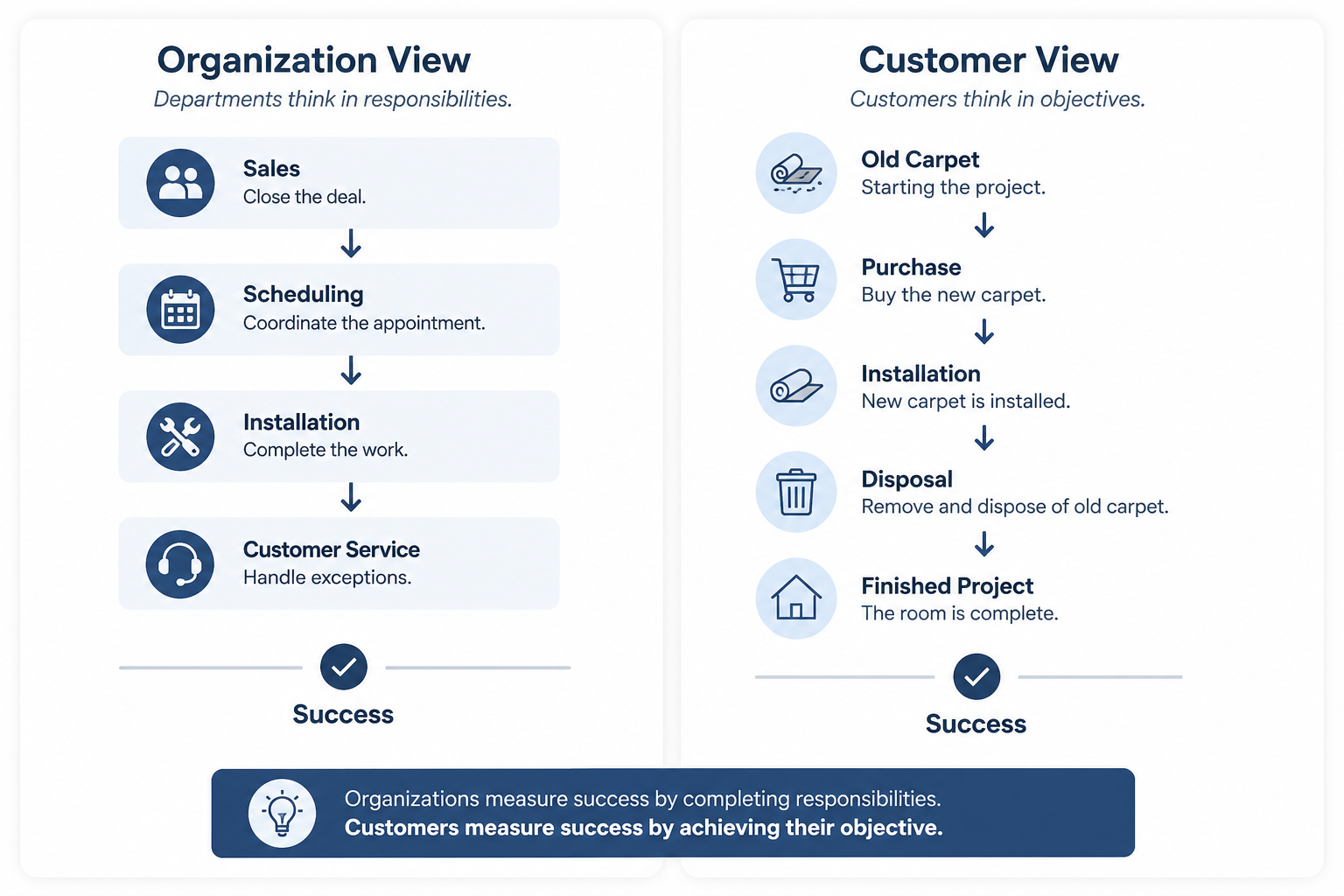
Viewed from inside the organization, nothing about this project appeared to have gone wrong. Every department fulfilled its responsibility. The sale was completed, the installation was scheduled, the installers arrived on time, and the carpet was installed successfully. Even when the disposal issue surfaced, customer service ultimately resolved it. From an operational perspective, the organization worked exactly as designed.
This is where many organizations unintentionally create blind spots. They measure success by whether each department completes its assigned responsibilities. Sales closes the deal. Scheduling coordinates the appointment. Installation completes the work. Customer service handles exceptions. Each team sees only the portion of the workflow that falls within its area of responsibility. That model works well for managing an organization. It does not necessarily work well for helping customers achieve their objectives.
The disposal policy illustrates the difference. It was not hidden from employees. It was well understood by the people responsible for installation. It simply entered the workflow too late to influence the customer’s decisions. By the time the policy was communicated, the purchase had been made, the installation was underway, and the customer had no meaningful opportunity to plan for the next step.
Nothing had failed inside the organization. The knowledge had reached every internal audience that needed it. It had simply failed to reach the one person whose decisions depended on it.
This distinction is easy to overlook because organizations naturally optimize around their own structure. Departments exist to divide responsibility, establish accountability, and improve operational efficiency. Those are worthwhile goals, but customers never experience the organization as a collection of departments, rather, they experience a single journey.
When knowledge remains confined within departmental boundaries, the organization may appear efficient from the inside while creating unnecessary friction for the customer. The result is not a breakdown in operations. It is a breakdown in how knowledge flows across the points where customer decisions are actually made.
That is the difference between managing responsibilities and architecting knowledge.
Information Architecture vs. Knowledge Architecture
Experiences like this are often described as communication failures, but I think that diagnosis misses the more interesting problem. This was not an Information Architecture failure.
If the policy had been missing from a manual, buried in an internal website, or unavailable to employees, then Information Architecture would have been the issue. Information Architecture is concerned with organizing, storing, and retrieving information. It answers questions such as, “Where does this information live?” and “Can the people who need it find it?” None of those questions applied here. The information already existed. It was known by the people responsible for sales, scheduling, installation, and customer service. The organization did not have an information problem. It had a knowledge problem.
Knowledge Architecture asks a different set of questions. Who needs to know this? When do they need to know it? What decisions will they be making when they receive it? What happens if they receive it too late? Those questions shift the focus away from documents and toward decisions. Knowledge has value only when it can influence an outcome. If it arrives after the decision has already been made, it may still explain what happened, but it can no longer change what happens next.
That is exactly what occurred in this case. The disposal policy was communicated accurately, but it arrived after the purchase had been made, after the installation had begun, and after the customer had lost the opportunity to make different plans. The knowledge was correct. The timing was not.
This is why I view Knowledge Architecture as fundamentally different from Information Architecture. Information Architecture is concerned with the organization of content. Knowledge Architecture is concerned with the movement of understanding through a process. It asks how knowledge should flow so that each participant, whether employee, customer, or increasingly an AI system, has the context needed to make the next decision successfully.
As organizations adopt AI, this distinction becomes even more important. AI can retrieve information almost instantly, but retrieving information is only part of the problem. The greater challenge is determining what knowledge should be delivered before someone realizes they need to ask for it. That is the point where Knowledge Architecture begins to move beyond search and into orchestration.
AI Reveals the Gap
This is where the conversation shifts from Knowledge Architecture to AI. Much of the discussion surrounding AI focuses on its ability to answer questions. We ask a chatbot for information, receive an answer in seconds, and conclude that faster retrieval is where the value lies. I think that is only the beginning.
Imagine the salesperson entering a few simple details into an AI assistant during the sales conversation. The customer has existing carpet. There are pets in the home. The carpet is heavily stained. An AI system with access to the organization’s knowledge should immediately recognize that this combination of facts has implications beyond the sale itself. It should explain the removal policy before the purchase is completed. It should explain why the policy exists so the customer understands that it is not an arbitrary decision. More importantly, it should recognize that the customer’s objective extends beyond buying new carpet.
The objective is completing the project. The customer did not walk into the store hoping to purchase carpet. They walked in wanting a room with new carpet and no old carpet left behind. Purchasing the carpet was only one step toward that objective.
This is where AI exposes a weakness that already exists inside many organizations. The knowledge required to help the customer succeed is often distributed across departments, systems, policies, and procedures. Employees learn to navigate those boundaries because they work within them every day. Customers do not.
An effective AI assistant should not simply retrieve the correct policy when someone asks about it. It should recognize that the conditions for that policy have already been met and deliver the knowledge before it becomes a problem. The value is not in answering a question more quickly; but in recognizing that the customer is about to need knowledge they do not yet know to ask for.
That is a fundamentally different way of thinking about AI. It is no longer acting as a search engine or an intelligent FAQ. It is participating in the organization’s decision-making process by moving knowledge to the right place before the next decision is made. Once you begin looking at AI through that lens, the next question becomes obvious. Why should the knowledge stop at the edge of the organization?
The Organization Ends Too Soon
Once the AI has explained the company’s policy, most organizations would consider the interaction complete. The customer has been informed. The question has been answered. The responsibility has been fulfilled. From the organization’s perspective, that may be true but from the customer’s perspective, the real problem has only just begun.
The customer still has a room full of old carpet that must be removed and disposed of before the project can truly be considered complete. Knowing the policy explains why the installer cannot help, but it does nothing to help the customer achieve the objective that brought them there in the first place. This is where Knowledge Architecture should continue beyond the boundaries of the organization.
Imagine the AI responding with something more than the policy itself. It explains that heavily contaminated carpet requires specialized disposal. It identifies reputable disposal providers in the customer’s area. It estimates the likely disposal cost and explains when those services should be scheduled. It may even coordinate the referral directly or provide links to schedule the work.
The AI is no longer answering a question. It is orchestrating an outcome. The organizations involved have not changed. One company sells carpet. Another installs it. A third removes and disposes of contaminated materials. From an operational standpoint, they remain separate businesses with separate responsibilities. The customer does not care. The customer cares that the room is finished.
This is an important shift in perspective. For decades, organizations have optimized the efficiency of their own internal processes. AI creates the opportunity to optimize something much more valuable: the customer’s complete journey, even when that journey extends beyond the organization’s contractual responsibility. That does not mean taking responsibility for work performed by other companies. It means recognizing where the customer’s journey continues and providing the knowledge needed to navigate the next step successfully.
In many industries, that may become one of the most valuable applications of AI. The organizations that create the best customer experiences will not necessarily perform every service themselves. They will be the ones that understand the entire ecosystem and use AI to guide customers through it from beginning to end. Knowledge Architecture, in other words, should not stop where the organization ends.
Organizational Cognition
The carpet installation was never really about carpet. It exposed a pattern that exists in organizations of every size and in every industry. Valuable knowledge often exists long before it reaches the people whose decisions depend on it. By the time that knowledge is shared, the opportunity to influence the outcome has already passed. That is not a failure of information. It is a failure of organizational cognition.
When I use the term organizational cognition, I am describing an organization’s ability to recognize what is happening, understand its significance, and move knowledge to the people who need it before the next decision is made. It is the organizational equivalent of situational awareness. This is where AI has the potential to become transformative. Not because it can read documents faster than humans or answer questions more quickly, but because it can recognize patterns that span departments, workflows, and even organizations. It can connect signals that no single employee is responsible for seeing.
More importantly, it can act before the customer experiences the problem. That is a profound shift in how we should think about AI. Instead of asking, “Can AI answer this question?” we should be asking, “What decision is about to be made, and what knowledge would improve it?” The first question treats AI as a sophisticated search engine. The second treats AI as part of the organization’s cognitive capability.
Every organization already possesses knowledge that arrives too late. Policies that are communicated after contracts are signed. Requirements that are explained after projects begin. Dependencies that become visible only after schedules have slipped. None of these are failures of competence. They are failures in the movement of knowledge.
Organizations that simply deploy AI will become more efficient at retrieving information. Organizations that redesign their Knowledge Architecture will become better at helping employees and customers make decisions before problems occur. The competitive advantage will not belong to the organizations with the smartest AI. It will belong to the organizations that have taught their AI how knowledge should flow. Because Knowledge Architecture does not begin with documents. It begins with understanding who needs to know what, when they need to know it, and what they are trying to accomplish when they receive it.
Where Does Your Organization End?
Most organizations have spent decades refining their internal operations. They have documented procedures, defined responsibilities, and invested heavily in systems that help employees perform their work more efficiently. Those investments are important, but AI is forcing us to ask a different question. Where does your customer’s journey continue after your organization’s responsibility ends?
For many businesses, the answer is surprisingly easy to find. A manufacturer hands the customer to an installer. An accounting firm hands them to an attorney. A hospital hands them to a rehabilitation provider. An IT consultant completes a project and leaves the client to operate the solution on their own. From the organization’s perspective, the work is complete. From the customer’s perspective, it is simply the next stage of the journey.
That is where hidden knowledge failures often emerge. Customers encounter predictable questions, dependencies, and obstacles that the organization has seen hundreds or even thousands of times before. The knowledge exists. The experience exists. Yet too often, neither is shared until the customer discovers the problem on their own. AI gives us the opportunity to change that.
Its greatest value may not be producing better answers, but recognizing where knowledge should move next. It can connect policies, procedures, institutional experience, and external resources into a single flow that helps customers achieve their objectives rather than simply complete another transaction. The organizations that gain the greatest advantage from AI will not necessarily be those with the largest models or the most sophisticated technology. They will be the ones that rethink how knowledge moves through their business and beyond it. They will recognize that customers do not experience departments, contracts, or organizational charts. They experience outcomes.
Conclusion
The lesson from my carpet installation had very little to do with carpet. It reminded me that organizations accumulate an extraordinary amount of knowledge about the problems their customers are trying to solve. Yet that knowledge is often distributed across departments, buried inside policies, or revealed only after the moment when it could have made a difference.
AI did not create that problem. It simply gives us a new way to see it. As organizations race to adopt AI, many are asking how the technology can answer questions faster, automate routine work, or reduce operating costs. Those are worthwhile objectives, but they may not be the most transformative ones. The greater opportunity is to rethink how knowledge flows through the organization and beyond it. To ask not only what employees need to know, but what customers need to know to successfully complete the journey they began when they chose to do business with you.
Knowledge Architecture is ultimately about organizational cognition. It is the discipline of ensuring that the right knowledge reaches the right person at the right moment to influence the next decision. If that knowledge arrives after the decision point, the architecture has already failed.
The organizations that gain the greatest advantage from AI will not be those with the most impressive models. They will be those that recognize AI as a catalyst for redesigning how knowledge moves across people, processes, and organizational boundaries in service of a single goal. Helping customers achieve the outcomes they came to accomplish.
That is where Knowledge Architecture begins.